







Does Clawhammer Fit into Bluegrass?
I had a student recently who has clawhammer lessons with me but is very keen on bluegrass. He told me a story about going to a Q and A with a bluegrass band and asking 'where does clawhammer fit into bluegrass'? The reply: 'it doesn't'! To me, this is yet another example of the strangely binary world that the banjo community often seems to live in! I have previously written about my puzzlement at clawhammer being thought of almost more as a genre than a technique. To me, it's what you play and the musicality with which you play it that matters. It is about adapting what you play to fit into whatever genre you're playing. The style you use to do that should be borderline irrelevant.
My experience of taking up clawhammer banjo is probably reasonably unique in the sense that I had never heard of bluegrass or old-time! I'd grown up listening to Irish jigs and reels played on what I now know to be a tenor banjo...so I ended up playing clawhammer style on a 5-string quite by accident, but by the time I realised I was hooked. But I grew into a pretty massive bluegrass fan in my teens after the Oh Brother soundtrack got me hooked. This influence and the Irish side of things have been the two driving forces behind my musical career.

My two main projects for some years now have been my solo work and my band, The Urban Folk Quartet. While the latter features some songs from the Americana and bluegrass canons, it's never really been the band to try out being a 'clawgrass' player (a brilliant term coined by Mark Johnson) – it's just not that kind of band. Solo-wise, I have recorded many songs over the years that are clearly bluegrass-influenced and more straight-ahead bluegrass in arrangement, but crucially, they have generally been performed solo. So my banjo part has had a significant nod to clawhammer staples such as bum-ditty and drop thumbing, and the driving rhythms, where I suppose I am loosely trying to cover the guitar and mandolin parts from a bluegrass band. But I also have always enjoyed 'converting' bluegrass licks to clawhammer. Much credit for this, as for most things, must go to my legendary banjo tutor George Davies, who did a lot of work with me during my university years in converting a three-finger tab to clawhammer note-for-note rather than 'clawhammerising' the tune! So I was even trying to keep the rolls of the three-finger tab in there, but executing it all using the clawhammer technique, albeit this did involve utilising every trick in the book! A recent example of this was when I went note-for-note on the classic Foggy Mountain Breakdown.
I very much enjoyed this as an exercise, but I confess that solo it can sound perhaps a little 'contrived' doing an entire three-finger piece note-for-note as per an original. It also perhaps takes away from one of the main strings that clawhammer has to its bow, that of being able to provide extensive chord and percussion sounds amongst the melody. So, for the solo banjoist, I still think clawgrass can be a thrilling effect, but perhaps incorporating the best of both worlds is the way to go. So put in plenty of bluegrass rolls 'borrowed' from three-finger style but executed in clawhammer, but keep the traditional clawhammer basis of driving brushes and drop thumbing in there too. I've certainly found the numbers where I do this can be a real hit at gigs.
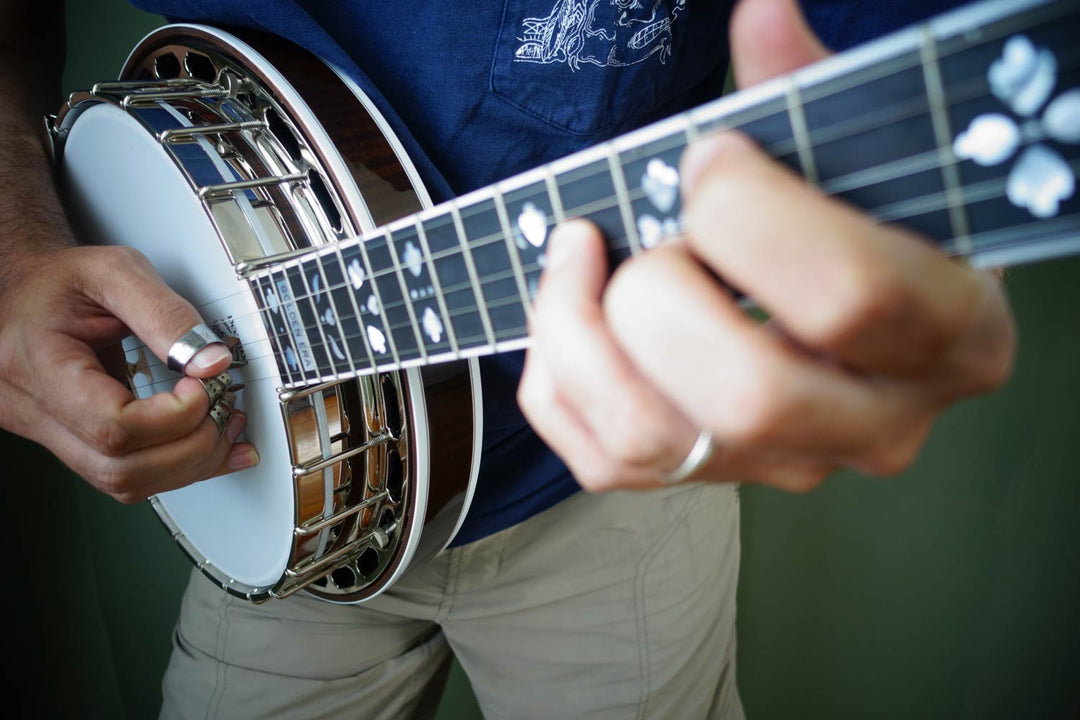
So, to return to the original story of 'clawhammer doesn't fit into bluegrass'...there's my defence for clawhammer being able to play the bluegrass genre solo, both stylistically and staying faithful to the qualities of the style. But can it fit into a bluegrass band? Well, the answer is yes but a qualified yes! Once again, it's about adaptation. If a banjo player goes into a bluegrass band and plays a bum ditty and trademark old-time clawhammer frailing, then it probably isn't adding a lot. The bluegrass band has such defined roles in the ensemble – the mandolin does the chops, the guitar does the strumming, the double bass does the root-fifth bass lines. There's no real need for another instrument to be playing the kind of comping that bum-ditty would be, which is why three-finger has been at the heart of bluegrass bands for so long. But this is my point – just do something that does work! It doesn't mean clawhammer can't fit in; it just needs to be adapted.
On my new album 'At The Station' (can't believe I've taken this long to mention it...) I ended up with a lot of new material that fitted more into the American bluegrass/Americana scene than usual. I decided, therefore, when I was thinking how to put my album together, to place clawhammer banjo at the centre of a bluegrass line-up. To make this work, I had to change the parts that I would play for these songs when I perform them solo. Solo, I'm required to add plenty of percussive and chordal work to stand up. But here the guitar, mandolin, and double bass do that for me...
So I brought out my full set of tricks to execute bluegrass rolls. Not all the tracks are out and out bluegrass by any means. But on songs like 'Move Away' and 'Some Might Say' in particular, I was very much trying to play a more three-finger style part but still in clawhammer. There's plenty of off-string pull-offs, drop thumbs, right-hand rolls (I mean in the clawhammer meaning of the word), and tricks to pull this off. On plenty of the other tracks, while I would still say it's a reasonably conventional clawhammer part in the sense of involving bum-ditty type rhythms and groups of two quavers rather than feeling threes as is often the way in Scruggs style, I was definitely very conscious that to make it a more suitable part for the band sound, I needed less chords than I would if I was playing solo and more of an arpeggiated texture, similar to that used in country music. So again, more drop thumbs and roll type patterns. I enjoyed the challenge very much!
I'm very pleased with the new album. I had a lot of new songs, so there is a ratio of eight songs and four instrumentals. I've always been known as a banjo player first and foremost, but I've also been a singer-songwriter, and I guess I've embraced that side a little more this time. For once, I think I've produced an album that can actually be vaguely fitted into a genre, but I hope there's still plenty of variety. The instrumentals "Acoustic Circus" and "Clatterbug" probably showcase the funky clawhammer thing that I've dabbled in for many years while January Waltz is one I really enjoyed playing in an unusual B minor tuning (take G tuning and detune both the Gs to F#) and embracing the mellower side of banjo playing.
But really, after many years of making albums where the variety of the banjo and the 'banjo nerd' aspect was very much on show, it was nice to make an album where I really didn't worry about it! I just went with songs and tunes that I enjoy and I hope you all will too.
Dan's new album "At the Station" is available now on Spotify, Apple Music, and anywhere you buy your music.


Great article! I agree that the banjo style takes its cue from the song or tune being played. I bring two banjos to jams and switch between two styles depending upon the song. BUT! Sometimes I play CH on a bluegrass style song – it just depends on the other instruments and what role I want to play.
Leave a comment